Since the start of his second term in January 2025, US President Donald Trump has taken a series of measures aimed at radically redefining US foreign policy. Among the most significant is the complete dissolution of USAID (United States Agency for International Development), the main operator of US humanitarian and development aid. This decision has dramatic consequences that profoundly upset the balance of international aid.
What is USAID?
Created in 1961 by President John F. Kennedy, USAID is the government agency responsible for implementing US foreign aid. Through its various programs, its main objectives are to promote sustainable economic development, improve health and education systems, and respond to humanitarian crises. In practice, USAID operates in 177 countries, in coordination with the United Nations, international NGOs, and local governments.
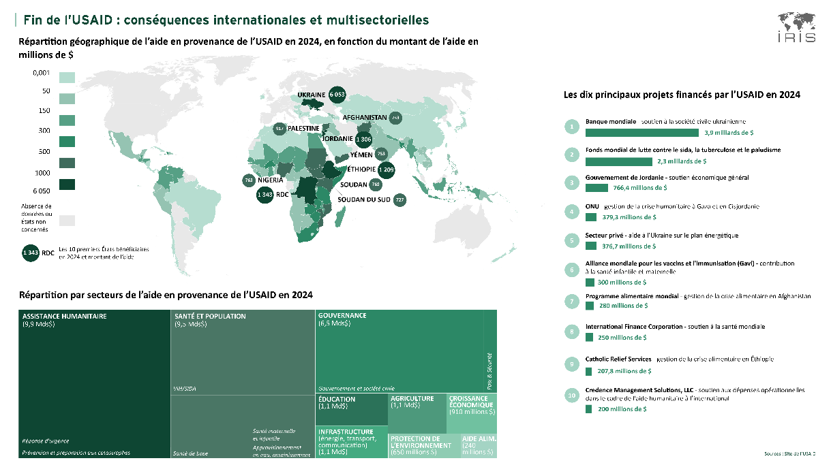
Its flagship programs include PEPFAR (the fight against HIV/AIDS), emergency food aid, vaccination campaigns, and support for the resilience of populations in the face of climate disasters. In 2024, USAID allocated more than $64 billion to humanitarian aid, representing 42% of global humanitarian aid. This figure logically placed the United States as the world’s leading donor of humanitarian aid.
The Trump administration decides to abolish USAID
On January 20, 2025, a few hours after his inauguration, President Trump signs Executive Order 14169, entitled Reevaluating and Realigning United States Foreign Aid. This order immediately suspends all USAID disbursements for a period of 90 days, pending a comprehensive audit.
Less than two weeks later, the government announces that the agency will be permanently dissolved. All of its activities are either canceled or transferred to the State Department, in line with a policy of diplomatic centralization. The Department of Economy and Government Efficiency (DOGE), headed by Elon Musk, claimed to have identified billions of dollars in “unjustified spending” and denounced “chronic inefficiency.”
Elon Musk went so far as to accuse USAID of being a “criminal organization” that “must die.” Despite a federal court ruling that the dismantling was unconstitutional, the Trump administration won its case. On July 1, 2025, the administrative closure of USAID took effect. Nearly 10,000 people lost their jobs, and thousands of partnerships with NGOs were broken or frozen, often without notice. In total, 94% of employees were laid off and 83% of the agency’s programs were eliminated.
Criticism of USAID
While this decision has sparked numerous reactions internationally, it is important to remember that USAID has also been the subject of criticism, sometimes long-standing and recurring, both in the United States and abroad.
Among the criticisms regularly levelled at USAID over the years, the issue of budgetary efficiency has often been central. Some US politicians have expressed doubts about the optimal use of public resources. In particular, they have pointed to an administrative structure that is considered complex, a lengthy decision-making process, and redundancies with other federal agencies. This critical view of fund management has often fueled debate.
The agency has also been at the center of controversies related to the nature of certain projects carried out in the field, particularly those concerning reproductive health, sex education, and LGBTQIA+ rights. Although these issues are part of a public health or human rights promotion approach, they have sometimes been perceived as out of step with the cultural realities or political sensitivities of certain partner countries. In this context, USAID’s actions have been accused of promoting Westernization. In the United States, too, these programs have been the subject of controversy, particularly among the most conservative elected officials.
USAID has a rich history, but it also has some gray areas. In several cases, notably in Cuba, Venezuela, and Iran, USAID has been accused of pursuing geopolitical ambitions. Local governments have criticized the US agency for supporting opposition movements through programs officially intended to strengthen civil society or promote democracy. Although the agency denies any partisan agenda, these perceptions have fueled a certain mistrust of its actions.
Finally, the issue of transparency and accountability has sometimes been raised, particularly with regard to the extensive use of subcontracting. A significant portion of the funds passed through large companies or private consultants, mainly based in the United States. This delegation of implementation may have complicated the assessment of the real impact of certain projects on the ground and raised questions about the cost-effectiveness of certain interventions.
These criticisms, although valid, do not obscure the massive impact that USAID has had on tens of millions of lives over the decades. According to the agency’s official data, between 2003 and 2023, the PEPFAR initiative alone saved more than 25 million lives by providing access to antiretroviral drugs for people living with HIV. In the vaccination sector, USAID-supported programs have helped immunize more than 3 billion children against preventable diseases such as measles and polio. In terms of food aid, the agency distributed the equivalent of 1.5 million tons of food each year in areas affected by humanitarian crises, from the Horn of Africa to Yemen and Haiti.
The Lancet study: a heavy human toll
On July 1, 2025, the official date of USAID’s dismantling, the prestigious medical journal The Lancet published a prospective impact study on the consequences of its disappearance. The results are alarming.
According to this model, if the cuts are maintained over time, this will represent 14 million preventable deaths that could occur by 2030, including 4.5 million children under the age of five.
The end of the PEPFAR program, which provided antiretroviral drugs and free testing to millions of people living with HIV, would lead to a massive resurgence of the epidemic in sub-Saharan Africa. Vaccination, child nutrition, and water sanitation programs in dozens of developing countries will also be affected. Many partner organizations that depend on USAID funding have already ceased their activities.
The international community, as well as some American figures, have expressed their concern. Former President George W. Bush called the decision “tragic,” while former United Nations Secretary-General António Guterres referred to a “humanitarian shockwave.”
Global challenges
Even though the International Federation of Little Brothers of the Poor and its members are not directly affected by this brutal decision, it seems essential to highlight its catastrophic consequences. The dismantling of USAID represents a veritable tsunami within the humanitarian and non-profit world. Thousands of organizations around the world will disappear, leaving their employees behind, but above all the millions of people who benefit from their actions. When safety nets disappear, millions of vulnerable people are plunged into extreme precariousness. Those most affected by the disappearance of USAID will be the people who depend on its actions. The most vulnerable will suffer.
To see the concrete impacts of the dismantling of USAID, Amnesty International went into the field. The NGO met with local actors around the world to see the unfortunate consequences of this decision. We invite you to read the article below to understand the reality of the issues at stake.
As actors in international solidarity, the International Federation of Petits Frères des Pauvres believes that solidarity knows no borders. Within our network, our common mission is to combat isolation and precariousness among older people. The issues are universal, and we believe that solidarity must be too. To act effectively together, we advocate sharing expertise, mutual aid, and pooling resources.
That is why we wanted to relay these facts, independently, to raise awareness of the humanitarian crisis that is unfolding. The stakes require us to clarify the context and give everyone the information they need to understand the situation. The direct consequences are concrete and now known to the populations concerned. This decision is not simply political or financial; it directly affects millions of human lives.
Sources:
Bush teams up with notorious Trump foes to trash ‘colossal mistake’ shuttering USAID
Agence des États-Unis pour le développement international — Wikipédia
U.S. Agency for International Development
En Afrique, l’onde de choc du retrait de l’Usaid sur la protection de la nature
Fin de l’USAID : conséquences internationales et multisectorielles – IRIS
Reevaluating And Realigning United States Foreign Aid – The White House U.S. seals USAID’s fate as State Department takes over foreign aid — What this means for Africa | Business Insider Africa